A new franchise can have the right premises, trained staff and a strong offer, then still face a quiet opening week. The missing piece is usually local awareness delivered early enough, often enough and to the right households. This franchise launch marketing example shows how a targeted leaflet campaign can build recognition before opening day and turn local interest into measurable footfall.
For a franchisee, the first few weeks matter. A strong launch gives the business visible momentum, helps staff settle into a busy operation and begins building the repeat customer base that makes a territory work. Relying on passing trade, a social post or a last-minute banner leaves too much to chance. Local people need a clear reason to notice the opening and act.
Franchise launch marketing example: a London opening
Imagine a new fitness franchise preparing to open near Wood Green. The brand is known nationally, but the local operator still needs residents within a practical travelling distance to know where the site is, when it opens and why they should join now.
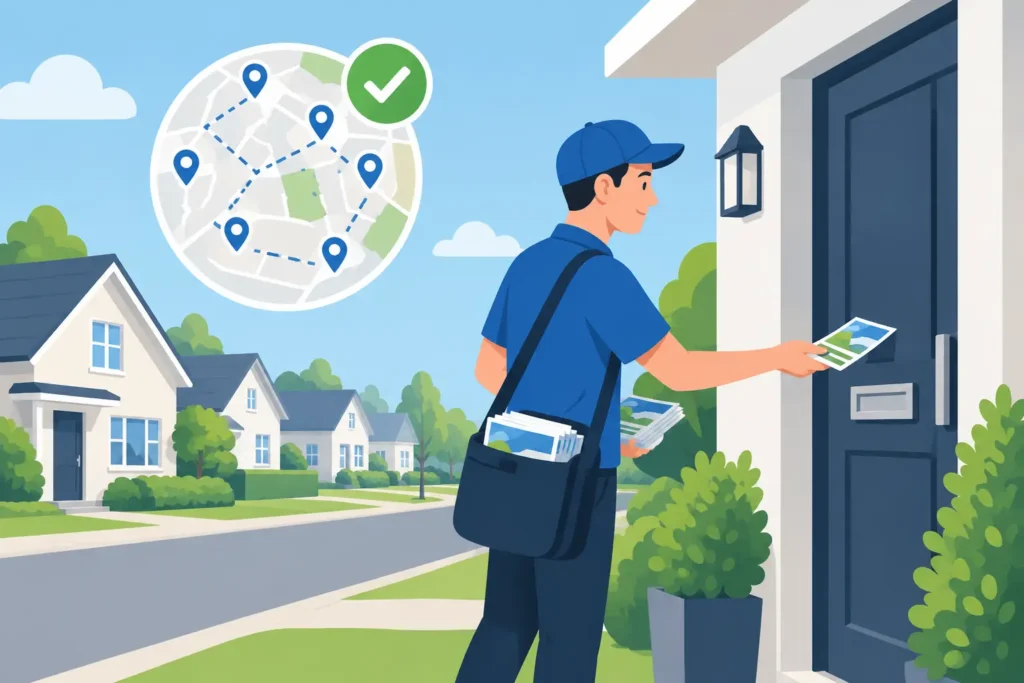
The campaign begins three weeks before launch. Rather than sending leaflets across every surrounding postcode, the catchment is mapped around the site. Priority goes to streets with the right mix of family homes, young professionals, renters and commuters, alongside nearby areas that have limited direct competition. The aim is not simply maximum volume. It is maximum relevance.
The first leaflet introduces the new location and makes the opening date impossible to miss. It carries a direct, simple offer: a free launch-week class booked using a unique code. A QR code takes recipients to a short booking page, while a telephone number gives less digitally confident prospects an easy alternative. The reverse side focuses on the practical reasons to choose the club – class times, facilities, parking or transport access, and the local team.
Seven to ten days later, the same core area receives a second drop. This version is built around urgency: opening this Saturday, limited launch-week places, book before the first session fills. Repetition matters because most households will not respond to the first piece they see. The second contact turns recognition into a decision.
On launch weekend, trained hand-to-hand teams work close to transport links, high-footfall retail areas and the immediate vicinity of the premises. They distribute a smaller, highly focused flyer that gives people something to use that day. The message is consistent across every stage, so residents who saw the door drop recognise the brand immediately.
Why this launch campaign produces a better response
A franchise launch is different from general advertising. It has a fixed date, a defined territory and a short period in which attention is at its highest. The campaign has to create familiarity before the doors open, then make action straightforward.
The strongest local campaigns combine reach with timing. A door-to-door leaflet reaches people where they live, when they have a moment to look at it properly. Hand-to-hand distribution reaches people while they are already out in the area and can visit, enquire or share the offer with someone nearby. Used together, these channels cover different moments in the customer journey.
The offer also needs to match the franchise. A restaurant may promote a launch-week tasting event or a redeemable introductory voucher. A children’s activity provider may invite parents to a free trial session. A home services franchise may offer priority booking for local residents. The right incentive should start a customer relationship, not just attract people who will never return.
Just as importantly, every response route must be trackable. Use a location-specific promotional code, a dedicated QR code or a short booking form that asks how the customer heard about the opening. This gives the franchisee evidence of which areas generated enquiries and which message prompted action. Offline marketing is far easier to assess when the campaign has been planned with measurement from the start.
Build the campaign before the opening date is fixed
Many operators leave local promotion until the signage is up and the opening date is close. That is when rushed creative, weak targeting and patchy delivery become likely. Give the campaign enough time to be planned around the real opening date, including contingency for fit-out delays or changes to staffing.
Start with the franchise brand guidelines, but do not let them make the leaflet generic. National branding creates trust; local details create relevance. Add the exact address, opening date, contact routes and a local reason to act. If the business serves a specific audience, show that clearly in the imagery and headline.
A good leaflet does not try to say everything. It should answer the questions a nearby prospect will ask in seconds: what is opening, where is it, why should I care, and what should I do next? Dense copy, several competing offers and vague calls to action reduce response. One clear action is usually stronger than five.
Print quality matters because a launch leaflet represents the standard of the new business. Clear design, readable type, accurate location information and a finish that suits the brand all help the material stay in the home rather than go straight into recycling. However, an excellent leaflet sent to the wrong streets will still underperform. Targeting and execution are inseparable.
Control the distribution, not just the design
A franchisee may have approval from head office and a well-designed flyer, but neither proves that households in the selected area received it. This is where campaign control becomes a practical requirement, not a nice extra.
For door-to-door distribution, ask how routes are allocated, supervised and verified. GPS-tracked delivery provides a record of where teams have worked, while active monitoring helps prevent missed streets and supports accountability. Reporting after the campaign lets the operator compare distribution areas against bookings, voucher redemptions and opening-week footfall.
Wendigo Distribution manages this process from campaign consultation through targeting, creative support, print and GPS-tracked delivery. For a franchise launch, that joined-up approach reduces the risk of different suppliers working to different deadlines or messages. It also means the local operator has one accountable team overseeing the campaign rather than a stack of separate tasks.
The same discipline applies to hand-to-hand activity. Teams should be briefed on the offer, the audience and where they are working. A flyer handed to someone outside the target area is not wasted in every case, but it is less likely to produce a useful local customer. High-footfall locations are valuable only when the people passing through can realistically use the franchise.
What to measure after the first drop
Do not judge a launch campaign only by how busy the opening day feels. Some people keep a leaflet and act days or weeks later, particularly for services that need consideration. Measure immediate signals, then continue tracking results through the early trading period.
Useful indicators include bookings from the code, QR scans, calls, walk-ins mentioning the leaflet, email sign-ups and redeemed vouchers. Compare those results by distribution zone if different codes or QR versions were used. This can reveal that one postcode, housing type or local route is producing more valuable leads than another.
There is a trade-off here. Using several versions gives better insight, but it adds operational complexity. For a first location, two or three area codes are normally enough to learn something useful without confusing the team or the customer. The key is to record results consistently.
If the first wave produces awareness but limited conversion, do not assume leaflet distribution failed. The issue may be the offer, landing page, opening date, booking process or follow-up speed. A prospect who scans a code and receives no quick response is easily lost. Local marketing performs best when the on-site team is ready to handle the demand it creates.
Extend the launch without losing urgency
Opening day should not be the end of the plan. Follow-up distribution in the strongest areas can convert households that noticed the franchise but did not act immediately. A second message can shift from “we are opening” to customer proof, introductory availability or a reason to visit before a deadline.
For franchises with a wider service radius, this later phase can expand into adjacent postcodes once the immediate neighbourhood is covered properly. For walk-in businesses, it may be better to stay concentrated near the site. It depends on the customer’s willingness to travel, the strength of the offer and whether the location is a destination or a convenience purchase.
The best launch campaigns make the new franchise feel established before it has been open for a month. Put a relevant offer in local hands, distribute it with proof of coverage, track every response route and keep the message moving while interest is fresh. That is how an opening becomes the start of a local customer base, not just a busy day.