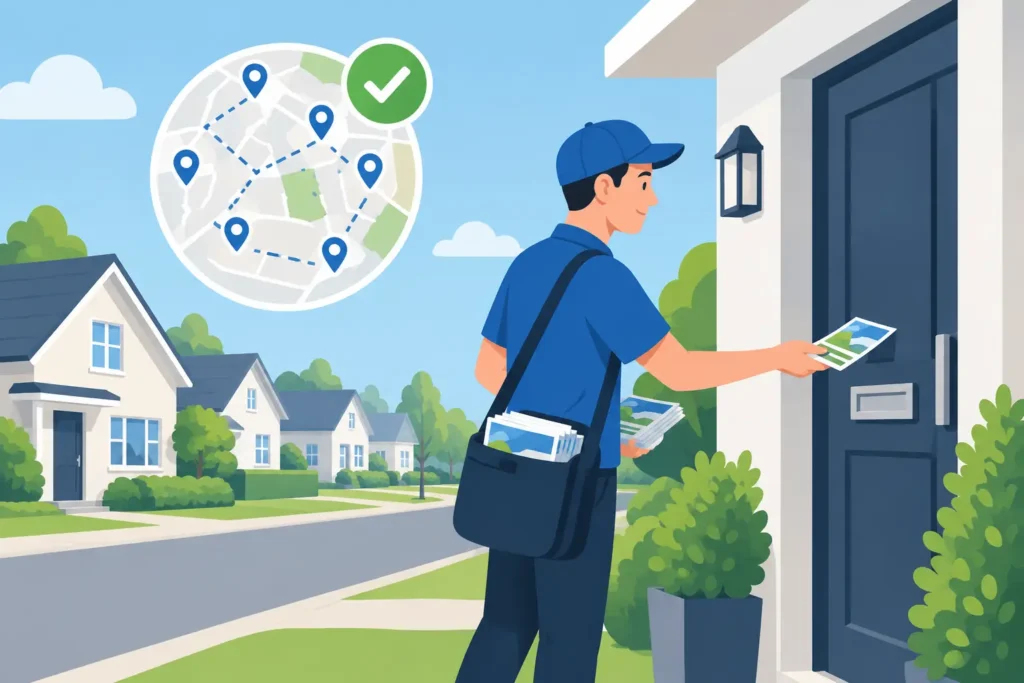
A leaflet pushed through a letterbox can be highly effective. But when a trained promoter places that same leaflet directly into someone’s hand at the right moment, it has a different job to do: stop them, start a conversation and prompt immediate action. That is the practical answer to the question, what is hand-to-hand marketing?
For London businesses competing for attention on busy high streets, near stations, outside venues or around local shopping areas, hand-to-hand distribution puts a physical offer in front of real people. It is direct, visible and fast-moving. Done properly, it is not about handing out paper at random. It is about placing the right message in the right hands, in the right area, with clear control over the campaign.
What is hand-to-hand marketing?
Hand-to-hand marketing is a form of face-to-face direct marketing where promotional materials such as flyers, leaflets, vouchers, brochures or event cards are personally handed to members of the public. A distribution team works at agreed locations and times to reach people passing through a targeted area.
The purpose is usually immediate local awareness. A new restaurant may use it to promote an opening offer near nearby offices. A gym may target commuters around a station. An event organiser may reach people close to a venue in the days before a show. Local service businesses can use it to put a clear offer in front of households and workers within their trading area.
Unlike digital advertising, there is no algorithm deciding whether your message is seen. Unlike door-to-door distribution, the recipient receives it directly while they are out, mobile and able to act. The contact is brief, but it is deliberate.
Why hand-to-hand marketing still gets attention
People are used to scrolling past adverts. A well-presented flyer, given politely by a professional promoter, creates a physical interruption that is harder to ignore. It can also give your campaign a human presence. The person receiving it can see that a business is active locally, rather than simply appearing as another advert on a screen.
Timing is one of the main advantages. A lunch offer works best before lunchtime. A takeaway promotion can perform well during the evening commute. A family event leaflet belongs near a relevant weekend footfall location, not in the hands of people rushing to work on a Monday morning. Hand-to-hand distribution lets you match the message to the moment.
It also supports rapid campaign launches. If you need to raise awareness of a retail opening, seasonal promotion, local event or time-sensitive service, a supervised field team can create concentrated visibility in a short period. Repetition matters too. Seeing your brand in a targeted area more than once makes the offer more familiar when the customer is ready to respond.
That said, volume alone is not a strategy. A generic flyer handed out in the wrong location will still be ignored. Results depend on the offer, the audience, the quality of the printed piece and the discipline of the distribution team.
Where hand-to-hand distribution works best
The strongest locations are places where the people passing by are likely to need, want or be able to use what you are promoting. In London, that might mean commuter routes, shopping streets, transport interchanges, business districts, leisure areas, markets, university surroundings or areas close to a venue.
A campaign for a local café, for example, may perform well around nearby offices and stations. A beauty or fitness business may focus on high-footfall retail areas within a realistic travelling distance of its premises. For a community event, the priority may be neighbourhood centres where local residents already spend time.
Footfall is valuable, but relevance is more valuable. A crowded location can waste stock if the audience is wrong. Before distribution begins, decide who you want to reach, where they are likely to be and what they should do after receiving the leaflet.
How to run hand-to-hand marketing that drives response
A successful campaign needs more than a box of flyers and a busy pavement. It needs a clear route from planning to reporting.
Start with a defined local audience
Be specific about the customer you want. Consider where they live or work, when they travel, what problem your service solves and how far they are willing to travel. A business serving a small local catchment should concentrate activity close to its premises. A larger brand may use several locations to build presence across selected boroughs.
Area targeting should also account for practical conditions. Weather, nearby works, school holidays, events and transport disruption can all affect footfall. An experienced distribution partner plans around these details rather than treating every street corner as equal.
Give people one simple reason to keep the flyer
The flyer must earn its place in someone’s pocket. Lead with a clear benefit: an opening invitation, limited-time offer, free trial, event date, booking prompt or useful local service. Do not make people search for the point.
Use a strong headline, readable text, recognisable branding and one primary call to action. If the goal is bookings, tell people how to book. If it is visits, show the location and opening times. If it is online redemption, use a memorable promo code or QR code that leads to a page built for that campaign.
Too many messages weaken response. A hand-to-hand leaflet has only a few seconds to make sense, especially when received during a commute.
Put trained people in the field
The person distributing your leaflet represents your business. They should be presentable, polite, alert and clear on who should receive the material. They should never obstruct the public, pressure passers-by or create litter around the distribution point.
Operational control is essential. Teams need agreed locations, start and finish times, sensible stock levels and active supervision. GPS-tracked monitoring can provide useful evidence that a team covered the planned area and followed the campaign route. It does not prove that every person read a flyer, but it gives businesses accountability for the work carried out on the ground.
Measuring a hand-to-hand marketing campaign
The most useful measurement begins before the first flyer is distributed. Add a campaign-specific promo code, QR code, phone number, landing page or offer wording so responses can be identified. Ask new customers how they heard about you, and make sure staff record the answer consistently.
Look beyond the number of flyers handed out. Track enquiries, voucher redemptions, bookings, website visits, store visits and sales during the campaign period. Compare response by location and time slot where possible. This helps you identify whether commuter traffic, retail footfall or residential centres are delivering the strongest results.
Distribution reporting matters as well. You should know where activity took place, when teams worked and how the campaign was supervised. Wendigo Distribution combines targeted planning with GPS-tracked distribution and campaign reporting, giving local businesses greater visibility over field activity rather than asking them to take delivery on trust.
For repeat campaigns, use what you learn. Keep the strongest locations, adjust weaker time slots, refine the offer and test a new headline or creative format. Small improvements in targeting and message clarity can make a major difference over several distribution runs.
Hand-to-hand marketing versus door-to-door distribution
Hand-to-hand and door-to-door leaflet distribution solve different problems. Hand-to-hand activity is designed for immediate exposure in public places. It suits time-sensitive offers, events, retail promotions and businesses that benefit from reaching people while they are already out and about.
Door-to-door distribution is better for broad household coverage across selected postcodes. It gives recipients time to read the message at home and can be particularly effective for trades, local services, restaurants, estate agents and businesses with a residential customer base.
Many campaigns benefit from both. Hand-to-hand creates a visible burst of local attention, while door-to-door reinforces the message across homes in the same catchment. The right choice depends on your audience, offer and the action you need people to take.
When hand-to-hand marketing is not the right fit
This approach is less suitable when your audience is highly specialised and difficult to identify in public spaces, or when the offer needs a long explanation before someone can decide. It can also struggle if there is no clear local location where likely customers gather.
In those cases, a more targeted residential campaign, direct outreach or a different marketing channel may be a better use of your effort. The point is not to distribute everywhere. It is to distribute where the opportunity is strongest.
A flyer handed directly to a potential customer is a small moment of attention. Plan that moment carefully, give it a clear purpose and make every distribution location accountable. That is how hand-to-hand marketing becomes a practical route to local enquiries, visits and growth.