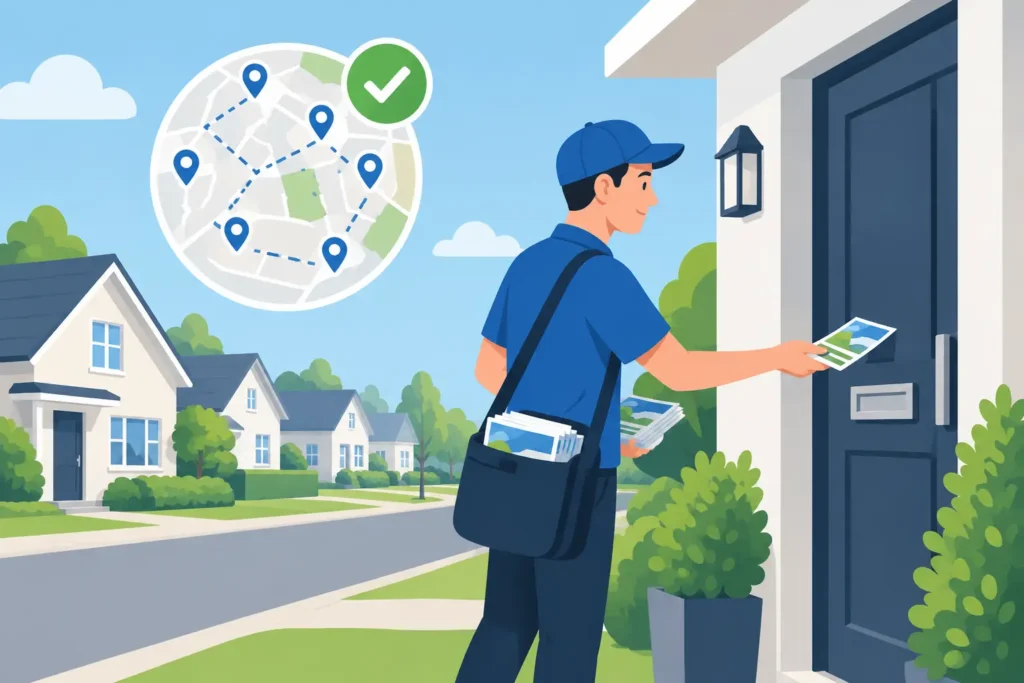
A leaflet campaign should not end when the distribution team completes its route. A proper campaign reporting guide gives you proof of where your material went, a clearer view of what customers did next, and the evidence needed to improve the next drop. For London businesses relying on local enquiries, bookings, footfall or event attendance, that control matters.
The strongest reports separate two questions that are often confused: was the campaign delivered as planned, and did it produce a commercial response? Delivery reporting proves coverage. Response reporting shows whether your message, offer and targeted area generated action. You need both to make informed decisions.
What a campaign report should prove
A useful distribution report is not a generic statement saying that leaflets were delivered. It should relate directly to the agreed campaign plan: the selected postcodes or streets, distribution dates, volume, format and delivery method.
For door-to-door activity, the report should show that the intended residential areas were covered. For hand-to-hand distribution, it should relate to the agreed locations, timings and audience conditions. A commuter-focused handout near a station, for example, needs a different record from a household leaflet drop in a targeted neighbourhood.
At a minimum, your reporting should make it easy to check:
- where distribution took place and whether this matched the agreed target area
- when the campaign was completed
- how the route or team activity was monitored
- whether any access, weather or operational issues affected delivery
- what evidence is available to support the reported coverage
GPS-tracked route data is particularly valuable because it moves the conversation beyond assumption. You can see the path taken by the distribution team and compare it with the planned area. It is a practical accountability tool, especially where several postcodes, large volumes or time-sensitive promotions are involved.
Delivery evidence is not the same as campaign success
GPS tracking, field supervision and completion records tell you whether a campaign was executed properly. They do not, by themselves, tell you why a household chose to call, visit or buy. That distinction protects you from drawing the wrong conclusion.
A fully covered area can still produce a modest response if the offer lacks urgency, the leaflet is unclear or the target audience is too broad. Equally, a strong offer can perform well in one postcode and quietly underperform in a neighbouring one. The report gives you the starting point for investigation rather than a reason to guess.
Think of delivery verification as the operational layer and response measurement as the marketing layer. When both are in place, you can identify whether the next improvement should be in the distribution plan, the creative, the offer or the follow-up process.
Set the measurement plan before printing
The most common reporting mistake happens before a single leaflet is printed. A business launches a promotion, then tries to work out afterwards which calls, web visits or walk-ins came from the campaign. By then, much of the useful evidence has gone.
Decide what counts as a response before your campaign begins. A restaurant may measure table bookings and voucher redemptions. A local trades business may measure qualified enquiries. A gym may focus on trial registrations, while an event organiser may track ticket sales or scans at the door.
Give recipients a simple, trackable next step. This could be a unique promotional code, a dedicated telephone number, a QR code leading to a campaign-specific page, or a clear instruction to quote a named offer. Use one main action rather than asking people to call, email, follow social media and visit a website all at once. A leaflet has seconds to earn attention.
If you are distributing across several locations, use different codes or response references by area where practical. That makes area-level learning possible. You may find that families respond more strongly in one residential zone, while a different message performs better near busy high streets or transport routes.
Choose measures that match the goal
Not every campaign needs the same dashboard. Measuring website visits alone can be misleading if your real objective is telephone bookings. Likewise, a high number of code scans is encouraging, but it is not the same as confirmed business.
For most local campaigns, track a small set of measures: confirmed coverage, responses, qualified leads or redemptions, and completed sales or bookings. Add average order value or repeat visits only when your systems can capture them reliably. A simple report that your team actually uses is better than a complicated spreadsheet full of incomplete data.
How to read GPS distribution reporting
GPS data is valuable when it is interpreted in context. A route trace should broadly correspond with the streets and sectors agreed for the campaign. It should show logical movement through the target area, rather than unexplained gaps or activity outside the plan.
Ask whether the timing makes sense too. A tightly supervised distribution run should have clear start and finish points, sensible route progression and enough time to cover the territory properly. Where access restrictions, gated properties or building entry issues arise, those should be identified rather than hidden.
GPS records are strongest when backed by active field management. Technology provides evidence; trained supervisors ensure the team follows the brief, handles material correctly and deals with real-world obstacles. This combination is what turns a distribution report into credible operational proof.
For businesses operating across London, this matters because neighbourhoods vary sharply. Dense blocks, restricted estates, mixed commercial streets and outer residential roads each require different route planning. A report should reflect that operational reality, not treat every postcode as identical.
Compare results without jumping to conclusions
Once the response window has passed, compare performance against your original objective and any previous campaigns. Look for patterns, but allow for context. Seasonality, school holidays, weather, local events and changes in your own availability can all affect results.
If one area generated more enquiries, do not automatically assume it is the best area for every future campaign. Check lead quality and completed conversions. A smaller number of high-intent enquiries can be more useful than a larger number of vague calls.
Also compare creative versions carefully. If you tested two leaflet designs, keep the target area, timing and distribution method as consistent as possible. Changing everything at once makes the result hard to interpret. A controlled test may feel slower, but it gives you a far better basis for scaling what works.
Turn the report into the next campaign plan
Reporting only delivers value when it changes the next decision. Keep the findings practical. Continue with postcodes that produce worthwhile responses, refine areas that show potential and remove locations that repeatedly fail to engage. Adjust the offer, headline or call to action where the coverage was sound but response was weak.
This is also the point to review internal follow-up. A leaflet can create demand, but slow call handling, missed enquiries or an unclear booking process can waste it. Make sure staff know the offer, can record the response source and have capacity during the expected response period.
A managed partner such as Wendigo Distribution can provide the distribution control, GPS monitoring and documented campaign completion that local businesses need. The business should still own the wider measurement plan, because the best results come from joining reliable delivery with a clear route from leaflet to customer action.
Keep reporting useful, not decorative
The best report is one that helps you make a confident next move. It should show what was planned, what was delivered, what happened afterwards and what you will change. It does not need pages of technical detail that no one reviews.
Start every new leaflet campaign with a trackable offer, a defined response window and agreed coverage evidence. When the final figures arrive, you will have more than reassurance that leaflets went out. You will have a practical basis for building stronger local demand with every distribution run.