Friday at 5pm is when a lot of takeaway marketing gets tested properly. People are tired, hungry and making quick decisions. If your menu is already in their kitchen drawer, on the hallway table or pinned to the fridge, you are in the running. If it is not, you are asking them to discover you from scratch.
That is why flyer distribution for takeaway restaurant marketing still works. It reaches local households at the exact point where convenience matters most. Done properly, it puts your offer in front of people who can order tonight, not someday. Done badly, it becomes wasted print, weak targeting and no clear way to judge results.
The difference is not the flyer alone. It is the planning behind it, the area selection, the timing, the message and whether the delivery was actually completed where it was meant to be.
Why flyer distribution still matters for takeaways
Takeaways depend on local demand. Your customers are not spread evenly across the country. They are concentrated in delivery zones, clustered around certain postcodes, roads, estates and neighbourhoods. That makes leaflet marketing unusually practical for this type of business.
A social advert can be useful, but it competes with everything else on a screen. A printed flyer sits in the home. It can be seen by more than one person. It often stays around longer than digital marketers like to admit. For family households especially, printed menus still influence what gets ordered when nobody wants to cook.
Flyer distribution for takeaway restaurant campaigns also suits the buying behaviour. Ordering food is often a fast decision. People do not always research deeply. They choose what feels familiar, nearby and easy. A flyer helps build that familiarity before the order is needed.
There is also a trust factor. A well-designed, clearly branded menu delivered to the right homes can make a business feel established and dependable. That matters if you are trying to win first-time orders in a crowded area.
What makes a takeaway flyer campaign work
The strongest campaigns are built around relevance. That starts with geography. There is little value in blanket coverage if large parts of the area fall outside your delivery radius or contain households unlikely to convert. Better results usually come from focusing on postcodes you can serve efficiently and repeatedly.
Timing matters just as much. A flyer distributed on the right weekday can land before peak ordering periods. Some takeaways benefit from end-of-week drops when people are already thinking about an easy dinner. Others perform better with midweek distribution tied to quieter trading periods and specific offers.
Your message must also match the audience. A generic menu with no reason to act is weaker than a flyer that makes the next step obvious. People want to know what you sell, where you deliver, how to order and why they should choose you. That might be speed, portion size, a family deal, a lunch offer, a new opening or a clear local specialism.
This is where many businesses underperform. They produce a flyer that looks acceptable but says very little. The result is reach without response.
The offer needs to be simple
For takeaway leaflets, simple beats clever. A free item over a minimum spend, a percentage discount with a code, or a meal deal for households can all work if presented clearly. If the reader has to study the flyer to understand the benefit, you will lose orders.
That does not mean every campaign needs a discount. Sometimes a new takeaway simply needs awareness in the right streets. Sometimes the most useful message is fast delivery, easy online ordering and a menu that suits local tastes. It depends on whether your problem is low awareness, weak repeat business or poor response in a specific area.
Design should support action
A takeaway flyer is not a brochure for browsing. It is a response piece. That means your logo, food category, delivery area, ordering details and offer should all be easy to spot in seconds.
Good design also reduces friction. If your phone number is hard to find, your QR code is too small, or your menu is cramped, you create hesitation. The same applies if your flyer tries to promote everything at once. A focused layout usually performs better than one overloaded with choices.
Targeting is where the real gains happen
For local food businesses, the biggest gains often come from smarter area selection rather than bigger distribution. A takeaway does not need broad coverage for the sake of it. It needs concentrated reach in places that can produce repeat orders.
That means looking closely at delivery zones, property types, household density and local demand patterns. Flats near busy commuter routes may respond differently from family streets. Student areas may favour one type of menu and timing, while suburban households may respond better to weekend family offers.
There is no universal map that works for every restaurant. A chicken shop, pizza business, Indian takeaway and sushi delivery brand may all need different area plans even within the same part of London. That is why campaign planning should be based on likely customer behaviour, not guesswork.
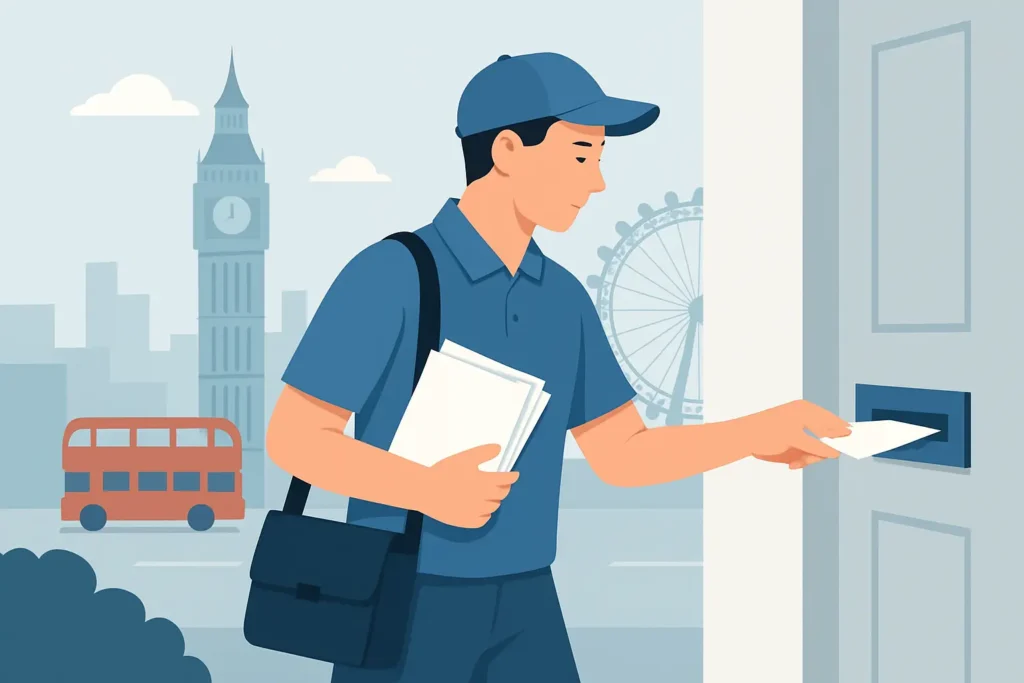
Reliable distribution also matters here. If you are targeting selected postcodes, you need proof the flyers reached those postcodes. Without that, it becomes difficult to judge the campaign fairly. GPS-tracked delivery and proper supervision give you control, which is especially important if you are comparing responses by area or repeating a drop.
Measuring results without overcomplicating it
A lot of takeaway owners assume leaflet marketing cannot be measured properly. It can. You just need a clean response method.
Promo codes are one of the easiest ways to track orders from print. So are dedicated offer lines, QR codes, flyer-specific landing pages or simply training staff to ask where the customer heard about you. None of these methods is perfect on its own, but together they build a clearer picture.
What you are looking for is not only immediate redemption. You also want to see patterns. Did one postcode outperform another? Did a Friday drop beat a Tuesday one? Did a family meal offer bring higher basket sizes than a discount code? These are practical questions, and leaflet campaigns can answer them if the distribution is controlled properly.
This is where a managed service has an advantage. If your campaign includes area planning, monitored distribution and reporting, you are in a much stronger position to improve the next drop instead of repeating the same assumptions.
Common mistakes that waste a campaign
The first mistake is choosing coverage that is too broad. More homes do not always mean more useful reach. If a large share of those homes are outside your best trading area, your message gets diluted.
The second is inconsistency. One isolated flyer drop can help, but repeat visibility is often what turns a household into a regular customer. People may keep the leaflet and order later. They may notice your brand on the second or third contact, not the first.
The third is poor execution. If distribution is rushed, unsupervised or impossible to verify, the campaign becomes hard to trust. For a takeaway depending on local acquisition, that is not a small issue. It affects confidence, planning and future spend.
The fourth is weak creative. If your flyer looks dated, lacks a strong headline or gives no obvious reason to order, even accurate distribution will struggle.
A better way to plan flyer distribution for takeaway restaurant growth
The most effective approach is simple. Start with your delivery radius and identify the neighbourhoods most likely to order regularly. Build a flyer around one clear message and one clear action. Distribute at the right time for your trading pattern. Then track the response and adjust the next campaign based on real data.
For some takeaways, hand-to-hand distribution near stations, high streets or lunchtime office clusters can support door-to-door coverage. For others, door-to-door is the stronger choice because ordering decisions happen at home. It depends on your menu, your strongest dayparts and the kind of customer you want more of.
If you want control over the process, work with a distribution partner that manages the campaign properly from planning through to delivery and reporting. That means support with targeting, design guidance if needed, and verified execution on the ground. A service-led approach removes guesswork and gives you a better chance of turning leaflets into real local orders. Wendigo Distribution does this with GPS-tracked campaigns, supervision and a money-back guarantee, which is exactly the sort of accountability takeaway operators should expect.
Takeaway marketing does not need to be complicated to be effective. It needs to be local, visible and reliable. Put the right flyer through the right door at the right time, and your next regular customer may already be deciding what to order.