A restaurant opening in Tottenham, a tradesperson covering Enfield, or a fitness studio filling trial sessions needs one thing from print marketing: the right households must actually see the offer. That is where the choice between door drops vs newspaper inserts matters. Both put a printed promotion into local homes, but they work in very different ways – and the differences affect targeting, visibility, reporting and response.
For many London businesses, door-to-door distribution provides greater control over where a campaign goes and how it is monitored. Newspaper inserts can still have a role, especially when a trusted local title reaches a defined readership. The best option depends on your objective, audience and how much campaign accountability you need.
Door drops vs newspaper inserts: the key difference
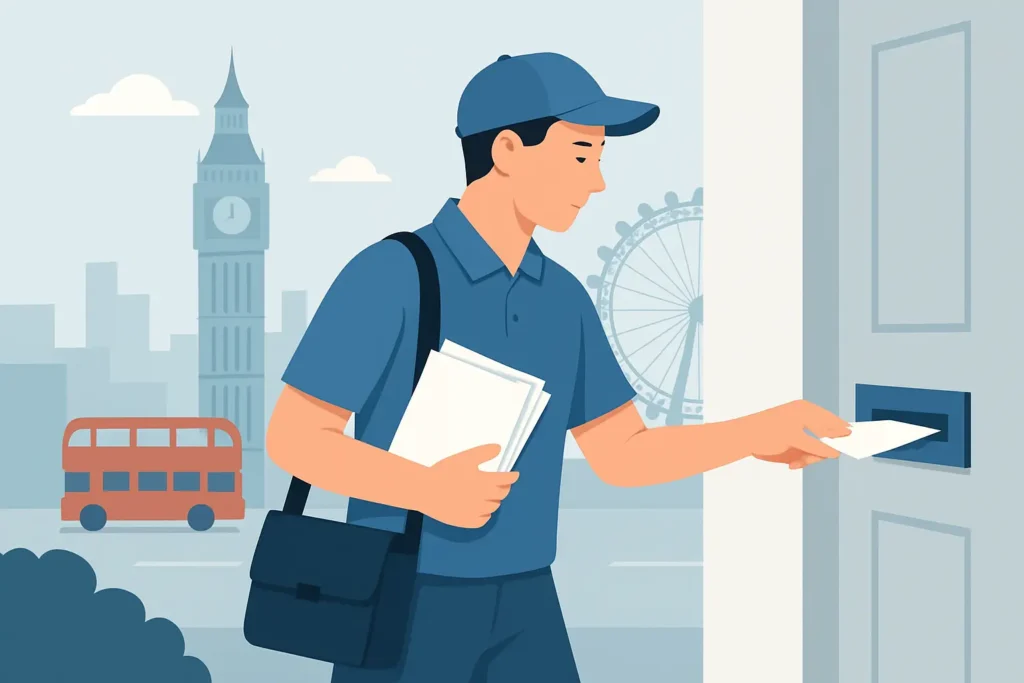
A door drop is delivered directly to a residential property, usually through the letterbox. Your leaflet, flyer, brochure or voucher is the item being delivered, either on its own or alongside other non-competing promotional material.
A newspaper insert is placed inside a newspaper or local publication before it is delivered or sold. The insert reaches people who receive or buy that publication, rather than every household in a selected delivery area.
That distinction sounds simple, but it changes the campaign completely. Door drops are built around household coverage in chosen postcodes. Inserts are built around a publication’s circulation and readership. One is a location-led distribution method; the other is a media-led placement.
When door drops are the stronger choice
Door drops are designed for businesses that need rapid, local visibility. If your service area is tightly defined, you can select the streets, postcodes and neighbourhoods that make commercial sense, rather than relying on the circulation footprint of a newspaper.
This is particularly useful for local services. A cleaning company may want to reach owner-occupied streets near its existing work. A takeaway may need households within its delivery radius. An estate agent may be promoting a valuation campaign around particular property types. In each case, the question is not simply who reads a local paper. It is which homes are most likely to respond.
Household reach, not reader assumptions
A newspaper’s readership can be valuable, but it is not the same as household reach. Some homes do not receive a local paper. Others may receive it but never open every insert. In busy households, promotional material inside a publication can be missed or discarded with the paper.
A door drop gives your promotion a clearer physical presence at the property. The leaflet can be displayed, passed between household members or kept near the kitchen table until an offer deadline. That does not guarantee a response – no marketing channel can do that – but it ensures the campaign is designed around delivery to the chosen homes, not access to a publication.
More control over areas and timing
London is not one market. A campaign that works in Walthamstow may not suit Ilford, Harrow or Hounslow. Door-to-door distribution lets businesses adjust the map around real operational needs: a new branch, a delivery zone, an event venue, a service radius or an area with proven demand.
Timing is also more direct. If you are launching a seasonal offer, opening a venue or promoting an event, the distribution can be scheduled around the dates that matter to your business. Newspaper insert timing is tied to the publication’s print and delivery cycle, which may be less flexible when a campaign needs to move quickly.
Stronger campaign accountability
The major advantage of managed door drops is the ability to supervise delivery. A reliable distributor should not ask you simply to trust that the work happened. They should provide clear evidence of coverage and a process for checking standards.
GPS-tracked distribution gives campaign managers visibility over delivery routes and targeted areas. Combined with trained teams, active supervision and post-campaign reporting, it creates a far more accountable process than sending leaflets out with limited oversight. For businesses that need proof their message reached intended postcodes, this is a serious operational benefit, not a minor extra.
Where newspaper inserts can still work well
Newspaper inserts are not automatically the weaker option. They can work when the publication has a genuinely loyal, relevant and local readership. A community event, public information campaign or business with broad appeal may benefit from appearing within a title people already know and trust.
The publication itself can add context. If readers spend time with a weekly local paper, an insert may arrive in a moment when they are already receptive to local news, events and services. This can be useful for messages that need explanation rather than an instant action, such as a community consultation, a new membership scheme or a detailed service launch.
However, results depend heavily on the publication’s real delivery standards, household penetration and reader habits. Ask practical questions before committing: which postcodes are covered, how many copies are delivered rather than printed, whether copies are free or paid for, and how the publisher verifies distribution. A large circulation figure alone does not tell you how many target customers will notice your insert.
Visibility: stand-alone leaflet or shared publication?
Your leaflet has to compete for attention in either format, but the competition is different.
With a newspaper insert, it sits among editorial pages, other inserts and potentially several advertisers. The trusted environment may help, but the leaflet has less control over the moment it is seen. Its size, position and format may also be governed by the publication’s requirements.
With a door drop, your print is the main promotional item arriving at the home. That gives the design more responsibility. A clear headline, local relevance, one strong offer and an obvious next step are essential. Avoid cramming every service, every social platform and every detail onto the page. A leaflet that can be understood in a few seconds is more likely to earn a second look.
For a local campaign, specificity often beats generic branding. “Free boiler quote appointments in Wood Green this week” is more actionable than a broad statement about excellent service. The offer must be genuine, the response route must be simple and the expiry date should give people a reason to act.
Measuring response properly
Neither door drops nor newspaper inserts should be treated as unmeasurable advertising. The response mechanism needs to be planned before distribution starts.
Use a distinct promo code, campaign-specific landing page, tracked phone number or simple booking question such as “Where did you hear about us?” For a multi-area door-drop campaign, use different codes by postcode group where possible. That helps reveal whether one territory is producing stronger leads than another.
Measurement is particularly valuable when you repeat activity. One distribution can create awareness, but a consistent presence can build recognition and trust. Tracking enquiries, bookings, voucher redemptions and repeat visits lets you refine the next wave rather than making decisions on guesswork.
Be realistic about attribution. Someone may keep a leaflet for weeks before calling, search for your business later, or respond after seeing both a flyer and an online advert. The aim is not perfect certainty. It is a reliable enough picture to identify what is driving local action.
Choosing the right format for your campaign
Choose door drops when precision, household coverage and distribution evidence are central to the brief. They are usually the better fit for trades, hospitality, retail, property, healthcare, gyms, delivery businesses and any organisation that needs to build demand within selected local areas.
Choose newspaper inserts when the publication has a well-established relationship with the exact audience you want and your message benefits from appearing alongside local editorial content. This can be effective for broad community messages, but it requires careful checking of the title’s true reach.
There is also a case for using both at different points in a campaign. An insert can support awareness among regular readers while door drops create focused coverage across priority streets. If you take that route, use separate codes or response routes so you can see what each channel is contributing.
Make distribution part of the campaign, not an afterthought
A well-designed leaflet cannot recover from poor delivery. Area selection, print quality, distribution supervision and response tracking need to work together from the start. That is why businesses looking for local acquisition should choose a partner that manages the full process and can stand behind the delivery work.
Wendigo Distribution combines targeted London coverage with GPS-tracked distribution, supervised teams and a money-back guarantee, giving businesses a practical way to put their message through the right doors with confidence.
The most useful question is not which format is universally best. It is this: do you need your message placed inside a publication, or do you need it delivered directly to the households most likely to become customers? Answer that honestly, then build the campaign around evidence, a clear offer and a delivery process you can verify.