A local offer has a short shelf life. If you need people in a specific area to notice you this week, not sometime next quarter, the real question is when should businesses use flyers and when should they choose something else. For many London businesses, flyers work best when speed, local visibility and measurable reach matter more than broad awareness.
Flyers are not a replacement for every marketing channel. They are a practical tool for getting in front of the right households, streets or footfall zones quickly. Used well, they support customer acquisition, store visits, bookings and event attendance. Used badly, they become background noise. The difference usually comes down to timing, targeting and execution.
When should businesses use flyers for best results?
Businesses should use flyers when they need a direct route into a local market. That is especially true when the audience is geographically concentrated and the message is simple enough to act on immediately. A new opening, limited-time promotion, local service launch or seasonal push all fit this model.
If your customer base lives, works or travels within a defined patch, flyers can do a job that many digital campaigns struggle with. They put your message physically in the customer’s hand or through the customer’s letterbox in the exact area you want to reach. For a restaurant in Tottenham, a gym in Enfield or a salon in Stratford, that kind of precision matters.
The format also suits businesses that need fast visibility without building a large in-house campaign. A managed leaflet campaign can move from planning to distribution quickly, which is valuable when a business wants momentum now rather than a long lead time.
New openings and local launches
A business opening in a new area often has one immediate challenge: nearby people do not know it exists yet. Flyers are effective here because they create awareness within the trading radius that matters most. A launch offer, opening date or introductory incentive gives people a reason to act now instead of vaguely remembering the brand later.
This is especially useful for franchises, takeaways, cafés, beauty clinics, estate agents and local trades. If the offer is relevant to nearby residents and the distribution area is well chosen, flyers can help turn an opening into an active customer pipeline rather than a quiet start.
Time-sensitive promotions
Some campaigns simply need speed. A weekend sale, half-term activity, last-minute event or limited booking window needs reach that is immediate and local. Flyers are strong when the goal is to fill tables, appointment slots, classes or attendance quickly.
This is one of the clearest answers to when should businesses use flyers. If the campaign has a deadline and the target audience is close by, printed distribution can create a strong burst of attention in a short period.
Local services with defined catchment areas
Flyers make sense for service-led businesses that operate within postcode-based territories. Cleaners, tutors, dentists, removal firms, builders, dog groomers and private healthcare providers often win business from nearby households. Their ideal customer does not need to be anywhere in the country. They need to be in the right roads and neighbourhoods.
In those cases, door-to-door distribution gives businesses control over where demand is generated. That matters more than vanity metrics. A thousand impressions in the wrong area are less useful than consistent visibility in the roads you actually serve.
When flyers outperform other channels
Flyers work particularly well when digital targeting is too broad, too competitive or too dependent on platform algorithms. That does not mean print beats digital in every case. It means flyers can outperform other channels when local coverage and physical presence are the priority.
For example, a business may run paid social ads but still struggle to build trust with older households, families or residents who respond better to something tangible. A flyer on the kitchen counter can stay visible for days. That kind of repeat exposure can help with services people buy only when the need appears, such as plumbing, removals or home improvement.
They also help when buyers are making quick, everyday decisions. Food offers, local entertainment, fitness trials and community events often benefit from physical prompts in the places where people live.
Door-to-door vs hand-to-hand
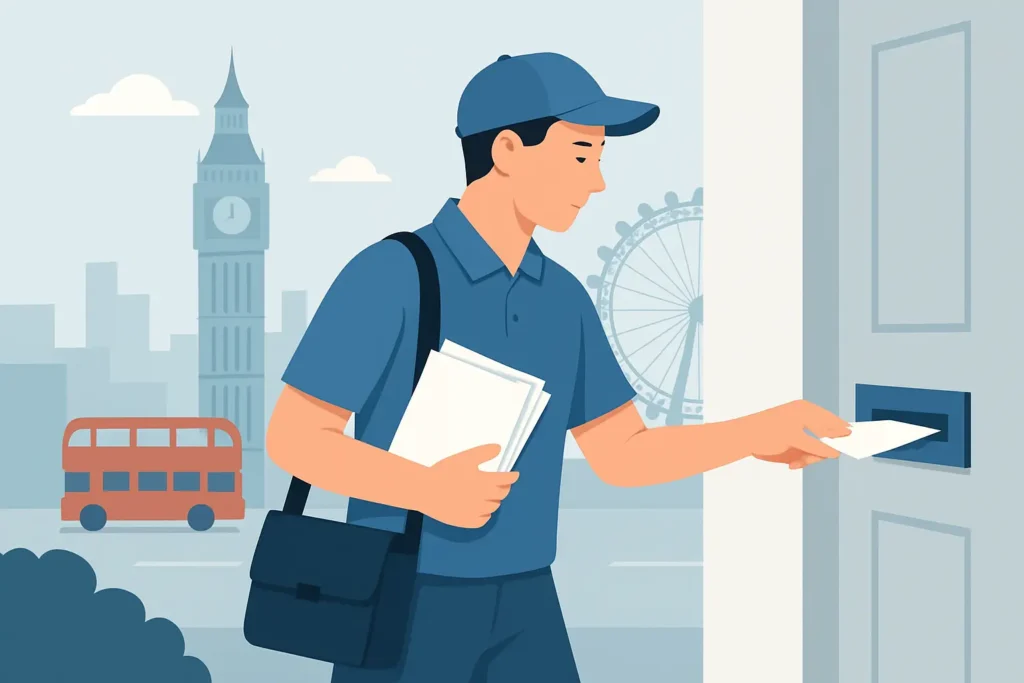
The right distribution method depends on behaviour. Door-to-door works best when you want household reach across a defined residential area. Hand-to-hand is stronger when timing and footfall matter, such as commuter routes, shopping areas, venues or event surroundings.
If you are promoting a takeaway menu, local service or neighbourhood gym, door-to-door is usually the better fit. If you are pushing a live event, student offer or retail opening where immediate action is likely, hand-to-hand can be more direct.
The point is not simply to print flyers. It is to match the format to how your audience moves and decides.
When businesses should not rely on flyers alone
There are situations where flyers should support the campaign, not lead it. If your product needs a long explanation, multiple stakeholder approval or national reach, flyers may play only a small role. They are built for clarity and local action, not for carrying a heavy technical sales message.
They are also less effective when the targeting is weak. If you distribute widely without clear audience logic, response tends to drop. A flyer campaign needs discipline. The right postcodes, the right volume, the right message and the right timing all matter.
Another weak use case is a business with no strong call to action. If the flyer does not give people a reason to visit, call, book or redeem, it is unlikely to do much. Print is powerful, but only when the offer is clear.
What makes a flyer campaign work in practice?
Most poor results come from one of three issues: bad targeting, weak creative or unreliable distribution. Businesses often focus only on the design, but the operational side matters just as much. If the right homes are not reached, the message never gets the chance to perform.
That is why accountable delivery matters. GPS-tracked distribution, supervised teams and reporting give businesses confidence that the campaign actually covered the intended area. For decision-makers under pressure to justify spend and drive local acquisition, that level of control is not a bonus. It is part of the campaign itself.
Creative matters too, but simpler usually wins. One main offer, one audience, one clear next step. A flyer should not read like a brochure unless the audience genuinely needs more detail. In most cases, direct-response structure works best: headline, benefit, proof, offer, contact point.
The best campaigns are built around local intent
Flyers perform best when they reflect what people in that area are likely to care about. That might be convenience, value, family-friendly offers, urgent service availability or a strong local opening message. A generic leaflet sent everywhere rarely matches the impact of a campaign shaped around the area and the likely customer.
In London, that local relevance matters even more because neighbourhoods differ sharply. What works in a dense commuter-led part of Central London may not be right for a residential patch in Chingford or a mixed high street area in Harrow. Good distribution is not just about coverage. It is about choosing the right ground.
Signs your business is ready to use flyers
If you need faster local awareness, have a defined service area and can present a clear offer, flyers are worth serious consideration. They are especially useful if your team does not have time to manage outreach internally and needs a done-for-you campaign from planning through to delivery.
They also suit businesses that want more than blind distribution. Reliable execution, monitoring and proof of coverage give campaigns a stronger footing, especially for multi-branch operators, busy local businesses and marketers who need accountability. That is one reason many firms choose a managed provider such as Wendigo Distribution rather than treating leaflet drops as an afterthought.
The strongest mindset is not asking whether flyers are old-fashioned. It is asking whether your audience is local, reachable and ready to act. If the answer is yes, flyers can still do serious work.
A well-timed flyer campaign puts your message where local buying decisions actually happen – at home, on the street and near the point of action. If your next move depends on getting seen in the right area quickly, that is usually the moment to put print to work.