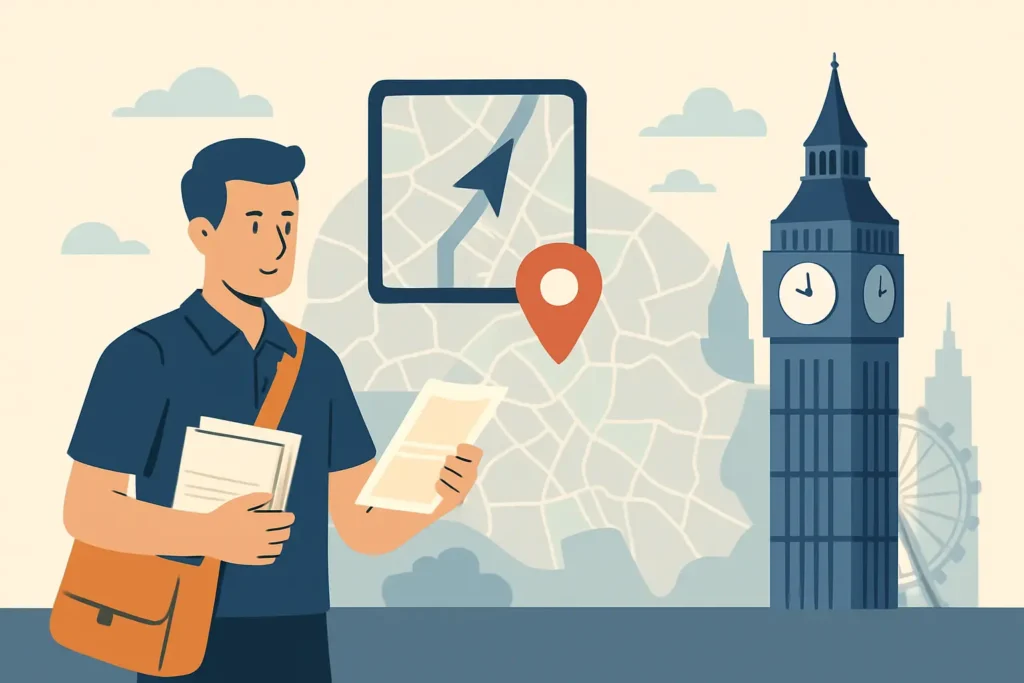
A café opens near a busy high street and wants footfall fast. A plumbing firm needs calls from the right postcodes, not just broad awareness. An estate agent wants full street-by-street coverage around a new instruction. That is where flyer distribution routes versus radius targeting becomes a real decision, not a marketing theory.
Both methods can work well. The right choice depends on what you are trying to achieve, how tightly you need to control coverage, and whether your campaign is built around actual walk routes or distance from a fixed point. If you want better response from leaflet distribution, you need to understand the difference before the first flyer is printed.
Flyer distribution routes versus radius targeting: what changes in practice?
At a glance, the two approaches can sound similar. Both are about getting your message into a defined local area. The difference is how that area is planned and how delivery is executed.
Distribution routes are built around real-world streets, housing patterns and delivery sequences. A route-based campaign maps exactly where distributors will walk, which roads will be covered, and how households are reached on the ground. It is operational by design. You are planning distribution as a physical job, not just drawing a shape on a map.
Radius targeting starts with a central point, such as your shop, venue, branch or event location, and creates a catchment area around it. That can be useful when proximity is the main factor in customer behaviour. If your business depends on people being nearby, a radius can be a sensible starting point.
The problem is that a radius is geometric. People do not live in perfect circles, and London certainly does not behave like one. Main roads, parks, rivers, estates, retail blocks and no-access buildings all affect what is realistically deliverable.
When route-based flyer distribution is the stronger option
If your goal is dependable coverage, route planning usually gives you more control. It works especially well when you need a managed campaign with clear accountability over where the leaflets went.
A route-led campaign is built from actual delivery logic. That means you can target selected streets, clusters of households, or defined sectors that fit your audience profile. For many local service businesses, that is a better match than a simple distance ring. A cleaner, dentist or takeaway does not just want homes within a mile. They want the homes most likely to respond and most practical to cover properly.
This approach also makes supervision easier. When routes are planned in advance, delivery teams can be monitored against real paths rather than rough territory assumptions. GPS tracking becomes much more meaningful in that setup because it supports evidence of route completion, not just presence in a general area.
That matters for campaign confidence. If you are trusting an external partner with 10,000 or 50,000 leaflets, you want to know the distribution was carried out as planned. Route-based work supports better reporting, tighter team management and fewer grey areas.
Where radius targeting makes sense
Radius targeting is not the weaker option by default. In the right situation, it is the cleanest and most commercial way to define an area.
If your business relies on short travel times or impulse visits, a radius can reflect how customers actually behave. Restaurants, gyms, salons, convenience-led retail and local events often benefit from targeting households within a practical distance of the venue. If someone is unlikely to travel beyond a certain point, there is no reason to spread leaflets wider than that.
It can also help at briefing stage. For businesses running their first leaflet campaign, saying “we want to reach homes within a mile of our branch” is a simple way to start the conversation. From there, the distribution plan can be refined into realistic streets and sectors.
The catch is that radius targeting still needs operational sense layered on top. A one-mile radius in central London is not the same as a one-mile radius in a suburban area. Housing density, access type and footfall patterns change the value of that circle very quickly.
The biggest trade-off: simplicity versus delivery control
This is usually the real decision behind flyer distribution routes versus radius targeting. Radius targeting is easy to understand and useful for defining local relevance. Route planning is stronger when campaign execution and proof of delivery matter most.
A radius gives you a broad strategic boundary. A route gives you a delivery plan.
For businesses that just need local awareness around a fixed site, the radius model can be enough if it is translated properly into streets. For businesses that need full coverage, selective postcode penetration or auditable execution, route planning is normally the better framework.
This is why experienced distribution providers do not treat targeting as a simple map exercise. They look at the campaign goal, the type of property being reached, and the operational reality of getting leaflets through the right doors.
How London changes the picture
In London, targeting decisions need more care because local geography can distort both models. A radius that looks sensible on a screen may cut through commercial blocks, transport links, inaccessible sites or areas that are irrelevant to your audience. A route-only plan, if done without strategic thinking, can also become too broad or miss the strongest pockets of opportunity.
That is why area knowledge matters. In places such as Enfield, Harrow, Tottenham or Haringey, the best distribution areas are often shaped by housing type, commuter flow, neighbourhood identity and shopping habits rather than raw distance alone. Two districts the same number of miles from your business can behave very differently.
For example, a school admissions campaign, estate agency instruction push or local trade service promotion often performs better when routes are built around strong residential clusters rather than a neat radius. On the other hand, a restaurant launch or gym opening may still start with a radius because convenience is central to response.
A better approach: use radius for planning, routes for delivery
In many campaigns, the smartest answer is not choosing one method and rejecting the other. It is using each for what it does best.
Radius targeting can help define the likely customer catchment. Route planning can then turn that catchment into a practical delivery map. That gives you strategic relevance without losing execution control.
This blended method is often the most reliable way to run leaflet distribution. It avoids the false precision of a perfect circle while keeping the campaign focused on people close enough to act. It also helps avoid wasted coverage in awkward or low-value sections of the map.
For businesses that want measurable local acquisition, this matters. You are not sending leaflets out to look busy. You are using print to generate visits, enquiries, bookings or redemptions in a specific area. The distribution plan should reflect that.
What to ask before choosing a targeting method
Before any campaign starts, ask a few direct questions. Is customer response driven mainly by distance from your site, or by the type of area being covered? Do you need blanket coverage, selective street targeting, or a mix of both? Is proof of delivery a key part of your decision-making?
Also consider what success actually looks like. If your campaign is tied to local awareness around an opening date, a radius may be a good starting point. If success depends on methodical household penetration across chosen neighbourhoods, routes are likely to serve you better.
This is where a managed distribution partner adds value. Good planning is not just about printing a map and sending a team out. It is about matching audience logic to delivery reality, then supervising the work properly. At Wendigo Distribution, that means GPS-tracked campaigns, monitored teams and reporting that gives businesses clear visibility over where activity happened.
The right choice depends on what you need to prove
If your campaign only needs a broad local footprint, radius targeting can do the job. If your campaign needs precision, consistency and confidence in the delivery process, route-based planning gives you a stronger foundation.
Most businesses do not need marketing jargon here. They need leaflets in the right hands, in the right streets, with clear evidence the job was done properly. That is the standard worth aiming for.
The best flyer campaigns are rarely built around theory alone. They work because the targeting method matches the buying behaviour of the audience and the way distribution actually happens on the ground. Start there, and your next campaign has a far better chance of producing the kind of response you can build on.